
Building Confidence in the Workplace
Confidence at work is not about walking into every meeting like nothing can touch you. Most people are not like that, and they do not need to be. Real workplace confidence is quieter. It is knowing your work, speaking clearly when it matters, recovering from mistakes, and not shrinking every time someone asks a difficult question.
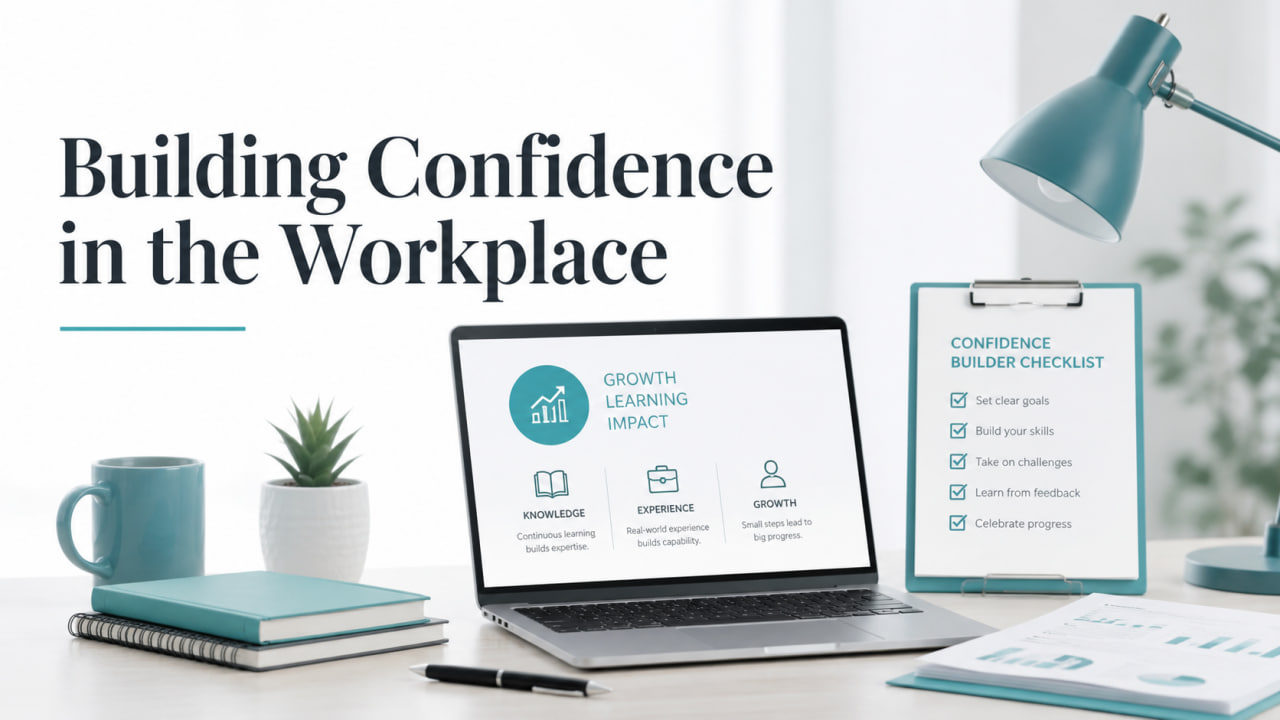
A lot of people think confidence is a personality type. You either have it or you do not. That is not very useful, and it is not really true. Confidence can be built. It often grows slowly, through competence, repetition, honest feedback and moments where you do something before you feel completely ready.
At work, confidence has a practical base. If you understand your role, know your subject, prepare properly and keep learning, you naturally start to feel less exposed. You may still get nervous. You may still overthink. But you are not empty-handed.
What workplace confidence really means
Workplace confidence is not the same as being loud, dominant or constantly certain. In fact, some of the most confident people at work are not the ones speaking the most. They listen well. They ask useful questions. They know when to say, “I need to check that,” instead of pretending.
Confidence is being able to participate without feeling like you must perform a perfect version of yourself. It is contributing an idea even if it is not fully polished. It is asking for clarification without deciding that everyone now thinks you are stupid. It is making a mistake and dealing with it, rather than turning it into a full identity crisis.
A simple way to think about it: workplace confidence is not “I will never get it wrong.” It is “I can handle learning, being seen and taking responsibility.”
Confidence starts with competence
It is difficult to feel confident when you do not understand what is going on. That does not mean you need to know everything. Nobody does. But the more you learn, the less easily you are shaken.
This is why books, experience, knowledge and practice matter so much. They give your confidence something to stand on. When you know your work, when you have seen problems before, when you understand the language of your field, you stop feeling like you are guessing your way through the day.
If you are trying to build confidence more broadly, not only at work, the page on Confidence Building Resources goes deeper into why knowledge, experience and self-respect create a stronger foundation than fake positivity.
Build knowledge in small layers
You do not need to become an expert overnight. Choose the part of your role that makes you feel most unsure and work with that first. Maybe it is presenting updates. Maybe it is understanding data. Maybe it is managing difficult conversations. Maybe it is simply knowing the systems better.
Small learning counts. Read internal documents. Ask someone to explain a process. Watch how confident colleagues structure their answers. Keep notes on repeated questions. Over time, these small layers create a feeling of steadiness.
Notice where your confidence drops
Most people are not equally unconfident everywhere. You may be confident with clients but nervous with senior managers. You may write well but hate speaking. You may be comfortable with familiar tasks but freeze when something is new.
This matters because “I have no confidence” is too broad. A more useful sentence is, “I lose confidence when I have to speak without preparation,” or “I doubt myself when I am around people who use a lot of jargon.”
| Where confidence drops | What may be underneath | What helps |
|---|---|---|
| Meetings | You wait for the perfect point and then say nothing. | Prepare one clear contribution before the meeting starts. |
| Presentations | You think nerves mean you are not capable. | Practise out loud and focus on the message, not on sounding flawless. |
| Feedback | You hear criticism as proof that you are failing. | Separate the useful information from the emotional sting. |
| New tasks | You expect yourself to be good before you have learned. | Ask what a good first attempt should look like. |
| Speaking to senior people | You treat their status as proof that your view matters less. | Prepare facts, stay concise and remember you are there for a reason. |
Once you know the situation, you can train for it. Confidence becomes less mysterious when you stop treating it as one giant personality problem.
Speak up without trying to sound perfect
Many people stay quiet at work because they are waiting for the perfect sentence. By the time they have shaped it in their head, the conversation has moved on. Then they feel invisible, and the pattern repeats.
You do not need to say something brilliant every time. Sometimes a useful question is enough. Sometimes repeating the key point clearly is enough. Sometimes saying, “I see one risk here,” is enough.
Use simple sentence starters
If you freeze in meetings, prepare a few phrases you can use without overthinking:
- “One thing I would add is…”
- “Can I check how we are defining success here?”
- “The main risk I see is…”
- “I agree with that, and I think we should also consider…”
- “My understanding is this. Is that right?”
These are not dramatic. That is the point. Confidence often grows through ordinary participation, not grand speeches.
Stop confusing feedback with failure
Feedback can hurt, especially if you care about your work. But feedback is not automatically failure. It is information. Some of it will be useful. Some may be poorly delivered. Some may not be accurate. Your job is to slow down enough to sort it.
If every correction feels like proof that you are not good enough, workplace confidence becomes very fragile. You start avoiding visibility because visibility might bring feedback. That keeps you safe for a moment, but it also keeps you smaller.
Try this after receiving feedback: write down what was said, what is useful, what you can change, and what you do not need to carry. This makes feedback practical instead of personal.
Confident people are not immune to criticism. They are just better at not turning one comment into a full story about their worth.
Use evidence, not just feelings
Feelings are real, but they are not always accurate. You may feel underqualified because you are in a new room. You may feel behind because someone else speaks faster. You may feel exposed because you are doing something for the first time.
Evidence gives you balance. Keep a simple record of things you handled well: a client conversation, a problem solved, a presentation completed, a deadline met, a colleague helped, a difficult email written clearly. Do not wait for huge achievements.
This is especially useful when you are considering growth, promotion or a bigger career move. If your confidence is connected to wider career decisions, the page on Career Planning Resources can help you connect your skills, evidence and next steps more clearly.
Question: what have people trusted you with at work, even if you keep dismissing it as normal?
Build confidence through preparation, not overthinking
Preparation helps. Overthinking drains. The difference is that preparation leads to action, while overthinking keeps asking for more certainty.
Before a meeting, preparation might mean writing one point, one question and one possible risk. Before a presentation, it might mean practising out loud twice and checking the structure. Before a difficult conversation, it might mean writing the first sentence so you do not avoid the topic completely.
Overthinking looks different. It keeps rewriting. It imagines every possible reaction. It tries to remove discomfort before you act. That rarely works, because some discomfort belongs to doing something new.
- Prepare the key point, not every possible sentence.
- Practise the first minute of a presentation more than the perfect ending.
- Write down the outcome you want from a conversation.
- Check facts before a meeting, then stop rehearsing imaginary arguments.
- Give yourself a time limit for preparation so it does not become avoidance.
Confidence at work also needs boundaries
It is hard to feel confident if you are constantly overextended. When you say yes to everything, reply instantly to everything and carry everyone else’s urgency, you may look helpful from the outside. Inside, you start feeling less in control.
Boundaries are not about being difficult. They are part of working like an adult. Clear expectations make better work possible. If you never protect your time, your confidence can slowly turn into resentment.
Small workplace boundaries
You can start small. “I can do that by Thursday.” “I need to finish this first.” “Can we confirm the priority?” “I will come back to you after I have checked.” These sentences are not rude. They are clear.
Confidence grows when you stop acting as if your own time and attention are always less important than everyone else’s.
Practise being visible in small ways
If visibility scares you, do not start with the biggest possible moment. Start smaller. Make one point in a meeting. Ask one question. Share one update. Volunteer for a manageable task. Send the draft. Apply for the role. Have the conversation.
The workplace rewards people who can be seen, but being seen does not always feel safe at first. You get used to it by doing it in doses. Every small visible action teaches your nervous system that attention is not the same as danger.
If you want a practical writing-based way to work through this, the guide to Personal Development Exercises includes exercises that help with confidence, decisions and self-trust.
What to stop doing
Confidence is not only built by adding habits. Sometimes it grows when you stop feeding the things that weaken it.
- Stop apologising before you have done anything wrong.
- Stop saying “just” before your point: “I just think…”
- Stop pretending you understand when you need clarification.
- Stop comparing your inside experience to someone else’s outside performance.
- Stop treating every mistake as proof that you should stay quiet.
- Stop waiting until you feel completely ready to take part.
These are small shifts, but they matter. They change how you hear yourself, and that changes how you show up.
How you know confidence is growing
Workplace confidence does not always feel like a big breakthrough. Sometimes it feels like less panic. You still prepare, but you do not obsess. You still feel nervous, but you speak anyway. You still care about feedback, but it does not ruin your whole day.
| Small sign | What it means | Next step |
|---|---|---|
| You speak earlier in meetings | You are reducing the habit of waiting for perfect timing. | Keep preparing one useful point in advance. |
| You ask clearer questions | You are choosing understanding over pretending. | Use questions as part of your professional voice. |
| You recover faster from mistakes | Your confidence is becoming less fragile. | Write down what you learned, then move on. |
| You stop over-apologising | You are taking up a more reasonable amount of space. | Replace apology with clarity where possible. |
Real confidence is built while working
You do not build workplace confidence by waiting until you feel like a finished person. You build it inside the work: by learning, asking, trying, speaking, adjusting, making mistakes and coming back with more understanding.
The more capable you become, the more stable your confidence feels. The more evidence you collect, the less power doubt has. And the more you practise being visible, the less strange it feels to be taken seriously.
You do not need to become loud. You do not need to become someone else. You need to become harder to shake because you know what you bring, you keep learning, and you are willing to take your place in the room.
Want to build confidence at work with support?
If workplace confidence is something you want to work on properly, coaching can help you understand the patterns behind the doubt and turn them into practical action.
Get in Touch