
How to Overcome Imposter Syndrome
Imposter syndrome is that uncomfortable feeling that you have somehow slipped into a room you do not fully belong in. You may be doing the work, getting results, receiving positive feedback, and still feel like someone is about to discover you are not as capable as they think.
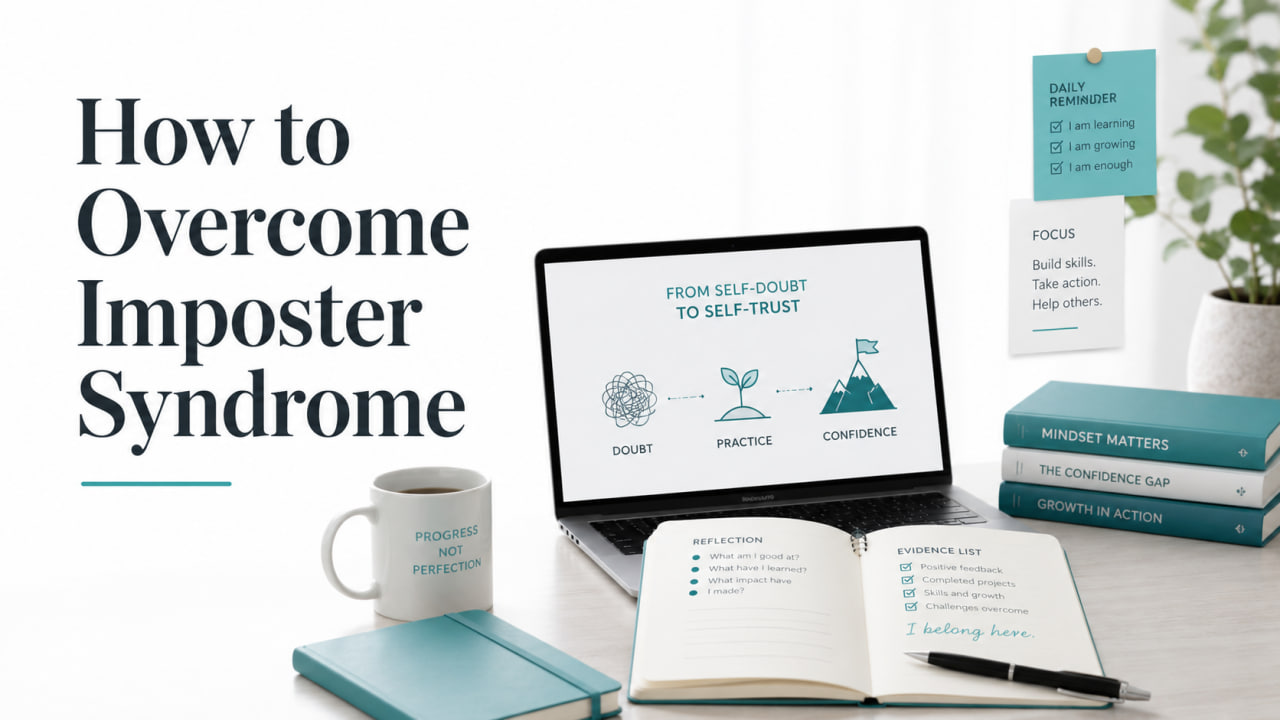
The frustrating thing about imposter syndrome is that it usually does not listen to logic straight away. Someone can praise your work and your mind says, “They are just being nice.” You can finish a difficult project and still think, “I got lucky.” You can be trusted with responsibility and quietly believe you are only one mistake away from being exposed.
This does not mean you are weak. It means your sense of ability has not caught up with the evidence. The work of overcoming imposter syndrome is not pretending to be fearless. It is learning to see yourself more accurately.
What imposter syndrome really feels like
Imposter syndrome is not just ordinary nervousness. Nervousness might show up before a presentation or a new task. Imposter syndrome goes deeper. It questions whether you deserve to be there at all.
It often sounds like this: “I only got this because they overestimated me.” “Everyone else knows what they are doing.” “I cannot ask a question because then they will know.” “If I make one mistake, the whole image falls apart.”
The problem is not that you care about doing well. Caring is healthy. The problem is when caring turns into constant self-monitoring, over-preparing, hiding, avoiding visibility or dismissing every piece of evidence that says you are capable.
A useful question: am I responding to the real situation, or to the fear of being found out?
Why it does not disappear after one success
Many people assume they will feel confident once they get the job, finish the course, earn the promotion or receive praise. But imposter syndrome has a way of moving the finish line.
You achieve something, then explain it away. You tell yourself the task was easy, the timing was lucky, the manager was generous, the standard was low, or everyone else could have done it better. This is how imposter syndrome protects itself: it refuses to let success count.
To overcome it, you need to stop treating every achievement as an accident. That does not mean becoming arrogant. It means being fair.
Start letting evidence land
Evidence can be simple. A problem you solved. A client who trusted you. A deadline you met. A piece of feedback that was specific. A time you learned something difficult. These things count, even if they do not feel dramatic.
If you struggle to recognise your own evidence, the guide to Confidence Building Resources gives a wider framework for building self-belief from knowledge, experience and real proof.
The main signs you are dealing with imposter syndrome
Imposter syndrome does not look the same for everyone. Some people become perfectionists. Some overwork. Some stay quiet. Some avoid opportunities. Some look confident from the outside but feel constantly tense inside.
| Pattern | What it sounds like | What it can lead to |
|---|---|---|
| Dismissing success | “It was not a big deal. Anyone could have done it.” | You never build confidence because no achievement counts. |
| Over-preparing | “If I do not know everything, I should not speak.” | You burn energy trying to remove all possible risk. |
| Avoiding visibility | “I would rather stay quiet than be judged.” | People may not see the value you can offer. |
| Comparing constantly | “Everyone else seems more natural at this.” | You compare your internal fear to other people’s external performance. |
| Fear of mistakes | “If I get this wrong, they will know I am not good enough.” | You treat normal learning as personal danger. |
Stop waiting to feel completely ready
Imposter syndrome loves the idea of readiness. It tells you to wait until you know more, practise more, polish more, prepare more. Sometimes preparation is useful. But sometimes it becomes a quiet way to hide.
You do not need to be reckless. You do need to understand that confidence often grows after action, not before it. You speak, then learn how to speak better. You apply, then learn where your CV needs work. You lead a meeting, then realise you survived the awkward parts.
The aim is not to remove discomfort. The aim is to stop treating discomfort as proof that you should not be there.
Instead of asking, “Am I ready enough to feel safe?” ask, “What is the smallest responsible step I can take while still feeling a bit unsure?”
Build an evidence file
This sounds simple, but it works because imposter syndrome is selective. It remembers mistakes quickly and forgets competence just as quickly. You need a place where the facts can collect.
Create a document or notebook section called “evidence”. Add anything that shows ability, progress, trust or learning. Keep it plain. No dramatic language needed.
- Projects you completed.
- Problems you solved.
- Positive feedback, especially when it is specific.
- Skills you learned through practice.
- Moments when someone trusted your judgement.
- Difficult situations you handled better than you expected.
Read it before interviews, reviews, presentations, applications or difficult conversations. Not to inflate yourself. To remember what fear edits out.
Make the evidence specific
“I am good at my job” may be too vague to believe. “I handled the client call when the timeline changed and helped the team agree a new plan” is better. Specific evidence is harder for your inner critic to dismiss.
Change how you speak to yourself after mistakes
Mistakes are where imposter syndrome gets loud. One small error can suddenly feel like proof of everything you secretly feared. You miss a detail, stumble in a meeting, receive feedback, or misunderstand something, and the mind says, “See? This is the truth.”
But a mistake is not a full identity report. It is information. Sometimes it means you need a better process. Sometimes it means you were tired. Sometimes it means you are learning. Sometimes it just means you are human.
After a mistake, ask: what happened, what can I repair, what can I learn, and what story do I not need to add?
That last part matters. The mistake may be real. The extra story — “I am not good enough, I should not be here, everyone knows” — may not be.
Stop comparing your inside to someone else’s outside
At work, it is easy to assume everyone else feels more certain than you. They speak smoothly. They ask confident questions. They seem relaxed in rooms where you feel tense.
But you are seeing their outside. You do not know how much they prepared, what they worried about earlier, how many mistakes they made before, or what they are still unsure about. You only have full access to your own internal noise, so the comparison is unfair from the start.
A better comparison is with your own progress. Are you asking better questions than before? Speaking a little sooner? Recovering faster? Learning the language of your field? Taking up slightly more space? That is the comparison that actually helps.
Practise being visible in small doses
If imposter syndrome has made you hide, visibility will feel uncomfortable at first. Start small. You do not need to take the biggest stage immediately.
- Say one useful thing in a meeting.
- Ask one question instead of pretending you already know.
- Share a draft before it feels perfect.
- Apply for one role that feels slightly above your comfort zone.
- Tell someone what you contributed, without shrinking it.
Small visibility teaches your nervous system that being seen is not the same as being exposed. You get used to attention by surviving it in manageable amounts.
If workplace confidence is where imposter syndrome shows up most, the article on Building Confidence in the Workplace gives practical ways to speak up, handle feedback and stop shrinking in professional situations.
Let learning be normal
A big part of imposter syndrome is the belief that capable people should already know. But capable people learn all the time. They ask. They check. They improve. They change their minds when new information appears.
You are allowed to be in progress. You are allowed to be new to a task, a room, a level of responsibility or a different kind of work. Not knowing everything is not proof that you are fake. It is proof that you are learning.
Try replacing “I should already know this” with “What do I need to understand next?” The second sentence gives you somewhere to go.
Talk to yourself like someone you are responsible for
This may sound simple, but it changes things. Many people with imposter syndrome speak to themselves in a way they would never use with another person. They are harsh, impatient and suspicious of every success.
You do not need to become falsely positive. You can be honest and still be fair. “That presentation was not perfect, but I prepared, delivered the main message and know what to improve next time” is more useful than “I was terrible.”
Fair language builds steadier confidence. It keeps you close to reality, rather than swinging between self-criticism and forced positivity.
Use reflection, but do not live inside your head
Reflection helps when it turns confusion into clarity. It becomes a problem when it keeps you circling the same fear without action.
If you keep replaying conversations, checking whether you sounded foolish, or imagining how people judged you, bring it back to something practical: what did I learn, what needs action, and what can I let go?
For structured prompts that help you sort through confidence, self-trust and decision-making, use the guide to Personal Development Exercises.
What overcoming imposter syndrome looks like
It may not disappear completely. That is fine. The goal is not to never feel doubt again. The goal is to stop letting doubt run the whole room.
You know things are changing when you can receive praise without instantly rejecting it. When you can make a mistake and repair it without collapsing. When you can say, “I do not know yet,” without feeling like a fraud. When you can take the opportunity even though part of you is nervous.
Overcoming imposter syndrome is not about proving you are perfect. It is about finally allowing the evidence of your effort, ability and growth to count.
Want support with confidence and self-doubt?
If imposter syndrome is keeping you quiet, stuck or constantly second-guessing yourself, coaching can help you understand the pattern and build more honest confidence.
Get in Touch